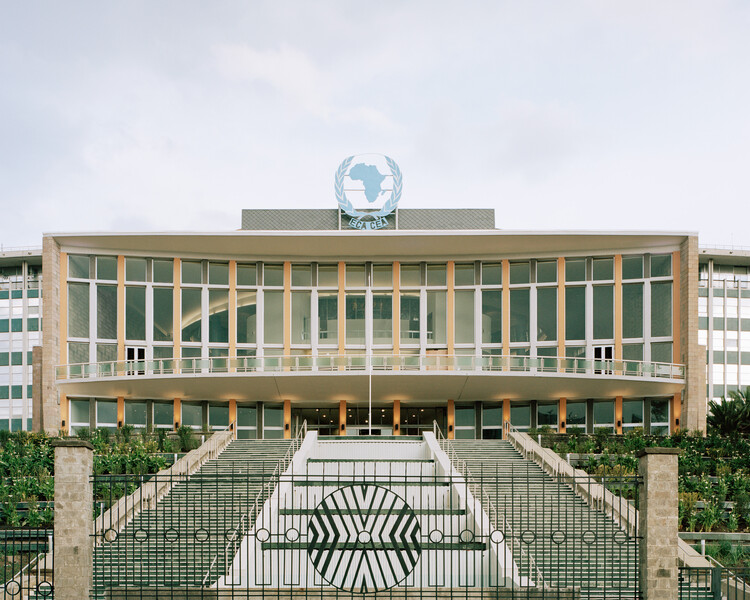
For years, one of the most important buildings on the African continent existed in a strange state of limbo. It was physically present, historically powerful, yet largely absent from public conversation. Many people knew of its significance, but few had ever seen its interior or thought deeply about what it represented.
Now, after a major restoration, the iconic structure in Addis Ababa has reopened, and its return feels bigger than the reopening of a historic building.
Completed in 1961, the building was commissioned by Emperor Haile Selassie as the headquarters of the newly formed Organisation of African Unity (OAU), now the African Union. At the time, the continent was in the middle of a political awakening. Countries were gaining independence, borders were being redrawn, and African leaders were trying to imagine what unity could look like beyond speeches and declarations.
This became the physical space for that imagination. It was where presidents, diplomats, and freedom fighters gathered to debate decolonisation, regional cooperation, and Africa’s place in the world. It wasn’t just a meeting venue; it was the symbolic heart of Pan-Africanism.
Architecturally, the building followed the modernist language of its era. Monumental but restrained, it relied on strong horizontal lines, open interiors, and a clear civic presence. Like many modernist projects of the 20th century, it was designed to express progress, order, and optimism through form, but the space was never just about architecture. Inside, large murals and artworks told stories of African history, resistance, and unity. Politics and culture were woven into the same environment. Diplomacy happened under images of liberation, making the interior as meaningful as the meetings themselves.

Left: Interior view of the Africa Hall, during renovation, 2022. Right: Interior view of the Africa Hall after renovation, 2024. Images via Alamy stock images/ Rory Gardiner / Collage by Soyinka Oluwadunmininu
For decades, this was one of the most powerful rooms on the continent, then, slowly, it faded from public life. The building remained in use, but access became limited, the interiors aged, and its story stopped circulating beyond official circles. Younger generations became familiar with the African Union as an institution, but not with the space where it was born- it became important, but invisible.
However, the recent restoration changes that. The decade-long restoration project was led by Architectus in collaboration with UNESCO and the African Union. Instead of redesigning the structure, the aim was careful conservation: repair what was damaged, restore what was lost, and update only what was necessary for it to function today.

Historic interior of Africa Hall in Addis Ababa, showing the 150 m² stained-glass window by Afewerk Tekle. Image via Lonely Planet.
Historic murals were cleaned and preserved, and the main assembly chamber was restored. Structural elements were repaired, while modern systems- lighting, acoustics, climate control- were quietly integrated. The goal was not to make the building trendy or contemporary in style, but to make it usable again without erasing its original character. Nothing was made flashy, nothing was replaced just for the sake of appearance. The building was allowed to remain itself and that decision is what gives the project its strength.
In a continent where development often means demolition, this restoration offers a different model. One where heritage is not treated as an obstacle to progress, but as part of it. For a long time, architectural preservation in Africa focused mainly on pre-colonial sites or colonial monuments. Modern African buildings, especially those from the 1950s to 1970s, sat in an uncomfortable middle space- too recent to be considered “historic”, yet too old to compete with new glass towers and mega-projects.
As a result, many important civic structures from the independence era were neglected, altered beyond recognition, or lost entirely.
This project quietly challenges that pattern. It suggests that Africa’s modern architecture is also heritage, that the spaces built during moments of political confidence and collective ambition deserve the same care, memory, and protection as any other historical period.
More importantly, it reframes what preservation means in an African context. This is not about freezing the past as the building is not a museum piece. It is still an active political space- leaders still meet there, decisions are still made there. It is not being remembered from a distance, it's being reused in real time.
The space now holds two timelines at once. It carries the memory of a generation that imagined African unity, and it supports a generation still trying to make it real. It functions both as a physical structure and a symbolic object- a real building, and a mental landmark.
Its restoration also sends a wider message to African cities. Across the continent, there are cultural centres, conference halls, and institutional spaces that once shaped national identity but now sit underused or forgotten. This project shows what becomes possible when those spaces are not replaced, but reactivated. It offers a future where development does not always mean erasure and perhaps that is why this reopening feels so important right now.
By reopening this landmark, Africa is not just restoring a structure, it's reopening a conversation about memory, significance, and how the built environment can carry both history and aspiration.
The building is back not as a monument to the past, but as a living reminder that architecture is never just about walls and roofs. It is about the ideas we inscribe in spaces, and the futures we choose to preserve.