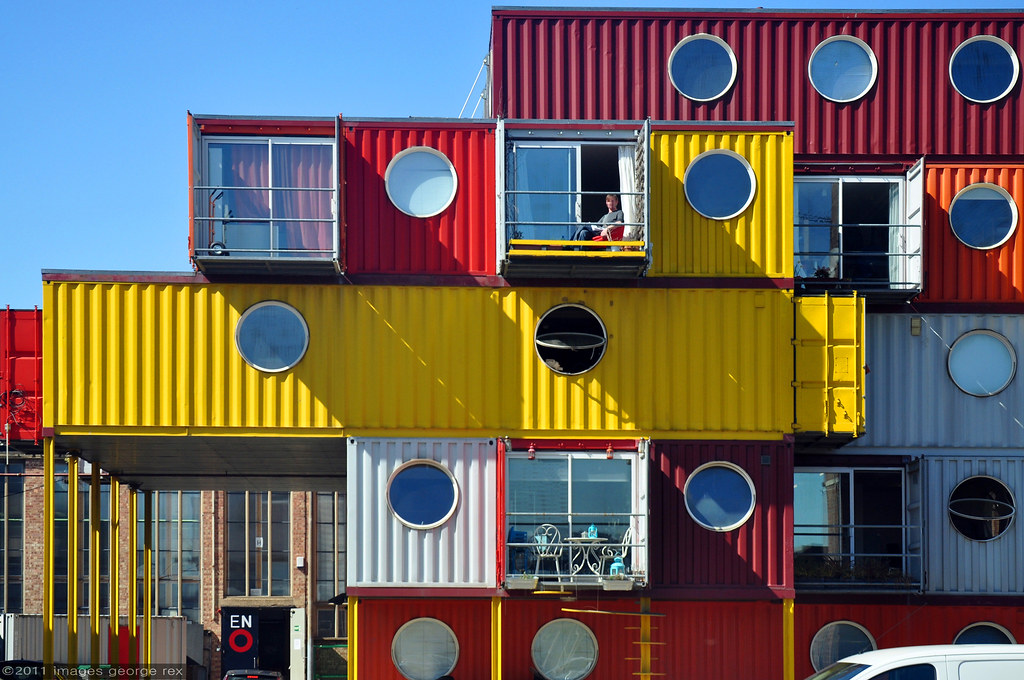
Most people think of scrap as the end of a story- leftover steel, used containers, weathered wood, materials that have already done their job. In architecture, those same materials are increasingly being treated as a starting point.
Across cities, architects are turning what would normally be waste into schools, homes, studios, and shops that people actually use every day. These are not experimental installations or one-off statements, they are functional buildings shaped by cost, climate, and urgency. Quietly, they are changing how value is measured in architecture, not by how new materials are, but by how intelligently they are used.
This shift matters because it reflects real conditions. Construction costs continue to rise, cities are growing faster than infrastructure can keep up, and sustainability is no longer a distant concern. At the same time, there is a growing understanding that good architecture is not dependent on pristine finishes, it depends on how well a building works.
Reclaimed and industrial materials offer practical advantages. Shipping containers are already engineered to be strong and modular. Salvaged timber carries structural integrity and history. When handled carefully, these materials allow buildings to be assembled quickly, adapted over time, and built with fewer resources. More importantly, they force architects to be precise. Layout, ventilation, daylight, and circulation become central, because design can no longer rely on surface polish to carry the work.
What’s striking about many reuse projects is how ordinary they feel once complete. They don’t announce themselves as experiments, people live in them, work in them, shop in them. Scratches, joints, and textures are not hidden but accepted as part of the building’s character, grounding it in everyday life rather than idealised perfection.
1. Container City I- London, UK.
Completed in the early 2000s, Container City I is one of the earliest and most referenced examples of container-based architecture. Built from stacked shipping containers, the project created affordable live-work spaces in a fraction of the time and cost of conventional construction.
What makes the building enduring is its clarity. The containers are treated as modular units, allowing the structure to expand and adapt over time. Interiors are well-lit and functional, and the building feels permanent rather than provisional. The project proved that reused materials could support long-term occupation without compromise.
2. Makoko Floating School- Lagos Lagoon.
In Makoko, a waterfront community in Lagos, architecture had to respond to conditions conventional buildings often ignore: flooding, limited land, and scarce resources. The Makoko Floating School, designed by Kunlé Adeyemi and NLÉ, used reclaimed wood and locally sourced materials to create a structure that floated on water.
Although the original building no longer stands, its importance lies in what it demonstrated. This was architecture shaped directly by environment and necessity, materials were chosen because they were available, affordable, and familiar. The triangular form provided stability, ventilation, and daylight, while the construction process involved local labour and knowledge.
Here, reuse was not a stylistic choice, it was a practical response to real conditions, showing how architecture can emerge from constraint rather than abundance.

Left: Interior spaces at Container City show repurposed shipping containers adapted for use, while right: Makoko Floating School in Lagos is a prototype floating structure built with local materials and buoyed on barrels. Images © Container City; NLÉ Architects / ArchDaily.
3. Freshforte- Lekki, Lagos.
Freshforte is a mixed-use retail and hospitality space in Lekki built from repurposed shipping containers. Designed by Studio Elementals Architecture, the project shows how reuse can work comfortably within Lagos’ fast-growing urban fabric.
The containers form a clear structural system, creating shaded walkways and flexible interior spaces suited to the city’s climate. Rather than feeling temporary, the building reads as intentional and permanent, proving that reused materials can support everyday commercial life.

Left: Freshforte in Lekki, Lagos is a mixed-use retail and hospitality space built from reused shipping containers and local materials, Right: its interior shows repurposed containers forming light-filled spaces designed for everyday use. Images via World-Architects / Studio Elementals Architecture.
Across these projects, a pattern emerges- reuse works best when it prioritises function over symbolism. These buildings succeed because they respond directly to climate, cost, and use, rather than trying to make a statement about sustainability.
Architecturally, this approach challenges long-held assumptions. It questions the idea that quality depends on newness, or that permanence requires expensive materials. Instead, it reframes architecture as an act of problem-solving, where intelligence matters more than excess.
Culturally, reuse-driven design signals a shift away from spectacle and toward usefulness. These buildings do not ask to be admired from a distance. They ask to be occupied, adapted, and lived in.
In a world where resources are increasingly constrained, architecture made from “scrap” is no longer a fringe idea. It is becoming a practical, grounded response to how cities actually work, and in many cases, it reminds us that architecture’s strength lies not in what is added, but in how thoughtfully we work with what already exists.