Cities rarely announce when they run out of space, they simply start to feel tighter- louder streets, denser blocks, and fewer places to pause. At some point, growth stops moving outward and begins to look for room elsewhere. That room is above us.
Across dense cities, rooftops are being reimagined as gardens, workspaces, cafés, cultural platforms, and shared social ground. Not as futuristic experiments, but as practical responses to pressure. When land is scarce, expensive, or already built over, the roof becomes the last flexible surface a city has. A building no longer ends at its roofline. Instead, the roof is becoming a continuation of urban life, carrying environmental, social, and spatial responsibility.
What gives rooftop spaces their power is not height, but reuse, they take surfaces that were once ignored and turn them into places of value. Rather than expanding cities outward, rooftops allow them to densify intelligently, adding activity without increasing footprint.
For architects, this demands a rethink as structural capacity, access, climate response, and safety matter at the top of a building. Shade replaces parapets as a design concern, while wind, heat, and drainage become spatial tools.
In cities facing heat stress, crowding, and limited public space, rooftops offer something increasingly rare: relief.
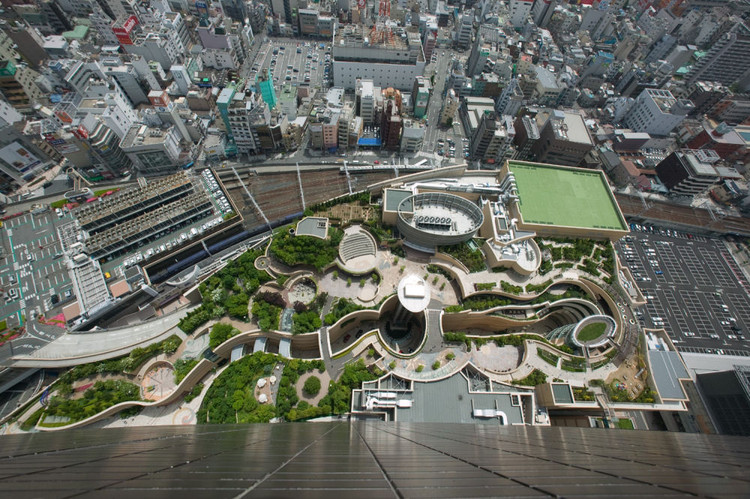
Namba Parks, Osaka.
Namba Parks shows what happens when a roof is treated as urban ground. Built on the site of a former baseball stadium, the project layers retail and offices beneath a stepped landscape that rises through the building.
Instead of sealing the structure with a flat roof, the architects designed a continuous park, planted terraces that climb upward, offering shaded paths, seating, and open air space in one of Osaka’s busiest districts.
The roof does more than look green, it cools the building, absorbs rainwater, and provides public space where none could exist at street level. Here, the rooftop is not decorative, it functions as infrastructure.
Zeitz MOCAA, Cape Town.
In Africa, rooftop spaces often respond more quietly, shaped by climate and civic needs rather than spectacle. At Zeitz MOCAA, the roof extends the museum experience beyond its galleries.
Terraces and viewing platforms provide controlled outdoor spaces with long views across Cape Town and the harbour. These elevated areas mediate light and heat while offering spaces to reflect rather than rush.
The rooftop becomes part of the public space, lifted above the city without disconnecting from it. It is intentional, and deeply civic.
Marina Bay Sands, Singapore.
Marina Bay Sands redefines what a rooftop can be in a dense city. Instead of treating the roof as an afterthought, the project turns it into a destination- the Sands SkyPark spans three 55-storey towers, creating a continuous public platform nearly 200 metres above ground.
The rooftop hosts gardens, viewing decks, restaurants, and the iconic infinity pool, offering uninterrupted views of the city. More importantly, it shows how rooftops can extend urban life vertically, providing social, recreational, and civic space where ground-level land is limited.
In this way, Marina Bay Sands demonstrates how rooftops can function as active urban infrastructure, not just an architectural spectacle.

Left: Terraced rooftop gardens at Namba Parks create a public parkscape above a busy urban centre, blending landscape and architecture, Top: the rooftop terrace at Zeitz Museum of Contemporary Art Africa in Cape Town and Bottom: the aerial view of Marina Bay Sands’ rooftop infinity pool show how rooftops are reimagined as civic and leisure spaces. Images via ArchDaily / The Jerde Partnership; Zeitz MOCAA Events; Wikimedia Commons / Wikipedia.
Across these examples, one idea connects them: rooftops work best when they are designed as spaces, not surfaces. When architects plan for people, climate, and movement at roof level, buildings gain a second layer of life above the street.
Beyond architecture, rooftop cities signal a cultural shift. As urban life grows denser, people look for separation from noise, traffic, and congestion, without leaving the city entirely. Rooftops offer that distance.
They also raise questions about access. Private rooftops reinforce exclusivity, shared ones expand the idea of public space vertically. How rooftops are designed, and who they are designed for increasingly reflects a city’s values.
Rooftop cities are not about novelty or trend, they are about adaptation. They respond to land scarcity, climate pressure, and density with a simple idea: use what already exists, better. When roofs are treated as real places- accessible, purposeful, and well designed, architecture becomes more resilient and more humane.
So, as cities continue to tighten, the future of urban space may not lie in expanding outward, but in finally paying attention to what has always been above us.